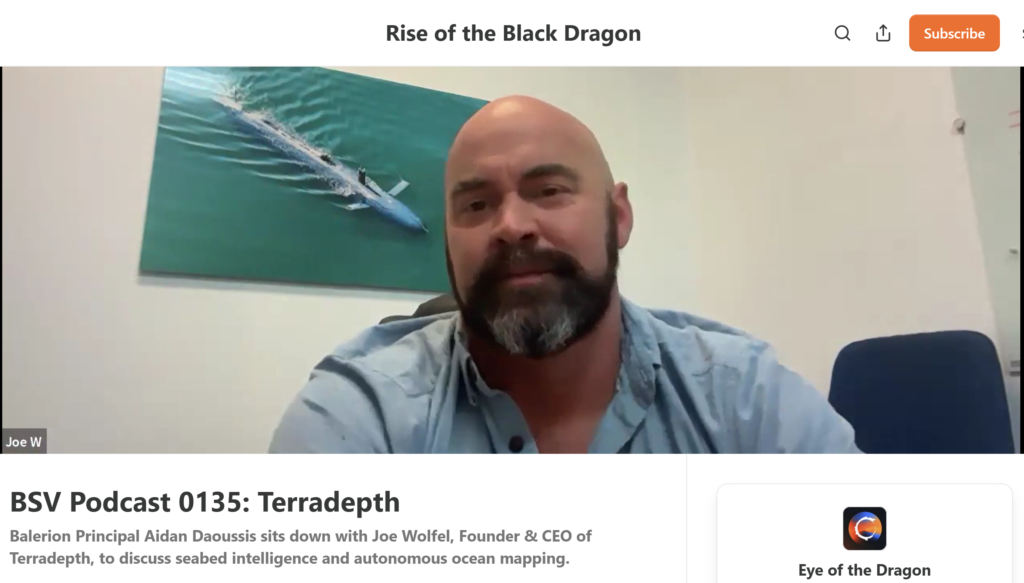
Balerion Space Ventures featured Terradepth Founder and CEO Joe Wolfel on Rise of the Black Dragon for a conversation on seabed intelligence, autonomous ocean mapping, and the infrastructure needed to make the ocean more observable.
Hosted by Balerion Principal Aidan Daoussis, the episode explores why the ocean remains one of the least understood domains on Earth and how Terradepth is working to change that. Wolfel discusses Terradepth’s Ocean Operating System approach, which combines autonomous subsea data collection, integrated geospatial data infrastructure, and applications that help turn seabed data into actionable information for commercial, government, and conservation use cases.
“You’re working on such an important industry that’s so much bigger than a lot of people realize.”
— Aidan Daoussis, Principal, Balerion Space Ventures
“That is the ocean operating system. It’s a digital infrastructure that enables activity in the physical world.”
— Joe Wolfel, Founder & CEO, Terradepth
Listen to the full episode on Balerion Space Ventures Substack:
Timestamped Overview
00:00 – Introduction to Terradepth and the challenge of ocean exploration
00:28 – Why the ocean remains poorly understood despite advances in satellites and remote sensing
02:17 – Terradepth’s mission and the three-layer ocean operating system
05:15 – Joe Wolfel’s Navy background and the origin of the company
10:40 – Autonomous underwater vehicles, sensing, data ingestion, and cloud infrastructure
12:20 – Why underwater sensing often requires acoustic systems instead of optical sensors
13:25 – Diesel-electric power architecture and the economics of subsea data collection
14:39 – What a future without Terradepth would miss in ocean intelligence infrastructure
17:00 – Parallels between space domain awareness and ocean situational awareness
18:33 – Seabed security, critical infrastructure, and the need to perceive underwater change
22:21 – Emerging underwater threats and the challenge of detecting stationary subsea objects
26:54 – Maritime chokepoints, the GI-UK gap, and scaled perception in strategic waters
31:27 – Terradepth’s customer base across government, commercial, and conservation markets
32:35 – Subsea infrastructure, fiber optic cables, pipelines, and future underwater systems
36:16 – Comparing the engineering challenges of operating underwater and in space
39:43 – GPS-denied operations, autonomous behavior, and designing for loss in the ocean
42:45 – Competitive dynamics, data ownership, and Terradepth’s compounding advantage
44:50 – Execution roadmap and the role of agentic AI, communications, and robotics
47:07 – Data ownership, Absolute Ocean, and the long-term vision for accessible seabed intelligence
48:47 – Closing thoughts on making the ocean as accessible as space is becoming